
Last Updated on November 24, 2026
Updated 24 November 2026 · Written by Tom Allan, Eco Happy (Gas Safe registered)
How to Repressurise a Boiler: A Step-by-Step Guide
- ⭐ Trustpilot 4.6 Excellent, over 650 reviews
- Gas Safe registered: 973154
- Price match on like-for-like quotes
Quick answer
To repressurise a boiler, switch it off and let it cool, find the filling loop under the boiler, slowly open the valves until the gauge reads between 1 and 1.5 bar, then close both valves fully. Pressure ranges vary slightly by make, so check your manual, and call an engineer if it keeps dropping.
Contents
Is it safe to repressurise a boiler yourself?
Yes, on most combi boilers it is a simple job that manufacturers describe in their own user guides, as long as the filling controls are easy to identify. The heating system is a sealed circuit filled with water, and over time a small amount of pressure can be lost. Topping it up adds water from the mains through the filling loop.
Ideal Heating notes that this guidance is for combi boilers where the filling loop or filling controls are clearly identifiable underneath or built into the boiler. System boilers and heat-only boilers may use an external filling loop elsewhere, for example near the hot water cylinder or in an airing cupboard, and the flexible hose may have been disconnected or removed. If that is your setup, or you cannot positively identify the correct valves, contact your installer or an engineer. Do not operate unidentified valves.
Step by step: how to repressurise a combi boiler
- Switch the boiler off (heating and hot water) and let the system cool. Pressure should be set when the system is cold.
- Read the pressure. Look at the gauge or the display. On boilers made from 2016 onwards the gauge is usually on the front, sometimes behind a drop-down flap. Check your user guide if you cannot find it.
- Find the filling loop. It is usually a flexible silver hose or a rigid pipe, shaped like a horseshoe, between two small valves underneath the boiler. If the hose is detachable, connect it with both valves closed, hand-tight.
- Open the valves slowly, one at a time, while watching the gauge. Where there are two, both may need to be open before water flows. The pressure can climb quickly, and you may hear water entering the system.
- Stop at the right pressure (see the table below) and close both valves completely. A valve left part open can keep pushing the pressure up.
- Remove the hose if it is a temporary one, and store it safely. Worcester says to disconnect an external filling loop after repressurising, to comply with water regulations.
- Switch the boiler back on. Some models need a restart or reset. The pressure may rise slightly as the system heats, which is normal.
If you overshoot, do not worry. Bleeding a little water from a radiator brings the pressure down. See our guide to boiler pressure too high.
What pressure should my boiler be?
| Make | Cold pressure | Notes from the maker |
|---|---|---|
| Worcester Bosch | 1 to 1.5 bar | Recharge if below 1 bar; on the Greenstar 4000, recharge if below 0.8 bar |
| Ideal | 1.0 to 1.5 bar | Once or twice a year topping up is not a concern |
| Glow-worm | 1 to 1.5 bar | Do not exceed 2.5 bar |
| Vaillant | 1.0 to 2.0 bar | Manuals show a restart at 1.1 bar after a low pressure fault |
| Baxi | 1 to 2 bar when filling; normally 1.0 to 1.5 bar | Below 0.5 bar the boiler shows an error; above 3 bar the safety valve operates |
| Alpha (E-Tec Plus NX) | 1 to 1.2 bar | Code 10 is insufficient system pressure |
| Potterton (Promax) | Green area, 1 to 2.5 bar | Repressurise if below 1 bar |
These come from each manufacturer’s own user and installation guides. Your model may differ slightly, so check the guide for your boiler. If in doubt, aim for the lower end of the range.
Repressurising and fault codes
Low pressure is behind many common fault codes. If your display shows one of these, repressurising is the first thing to try:
- Ideal F1
- Vaillant F22
- Glow-worm F22 or F9, see Glow-worm fault codes
- Baxi E118 or E119, see Baxi E1 error codes
- Alpha code 10, see Alpha error codes
- Worcester low pressure, see Worcester fault codes
How often is too often?
Ideal says a heating system can need topping up once or twice a year without a boiler fault. Small losses happen when air is released through vents, when tiny amounts of water escape at radiator valves or joints, and after maintenance. A drop over several months does not mean the boiler itself is faulty.
It becomes more likely there is a problem when pressure drops repeatedly over days or weeks, falls to zero, or needs frequent top-ups. Worcester’s user guide says constantly re-pressurising should be investigated, because it can indicate leaks and dilute the inhibitor that protects the system from corrosion. Check for leaks at pipework and radiator valves, and read boilers losing pressure and boiler leaking water.
Gas Safe warning
Do not open the boiler casing or touch gas, flue or other internal parts. Anything inside the boiler, including gas valves, burners, electrodes, fans, heat exchangers and circuit boards, must be dealt with by a Gas Safe registered engineer. If you smell gas, suspect a gas leak or flue fumes, or a carbon monoxide alarm sounds: turn off the gas at the meter if it is safe to do so, open doors and windows, do not use light switches or anything electrical, leave the property and call the National Gas Emergency Service on 0800 111 999.
When to call an engineer
- You cannot identify the filling loop or valves.
- The pressure will not rise, or rises and falls again within days.
- There is water dripping from the boiler or the pressure relief pipe outside.
- The boiler shows a pressure fault with the gauge in the right range.
- You are bleeding radiators every few weeks.
If the boiler is old and losing pressure regularly, ask for a quote for repair and compare it with a new boiler. Our beyond economical repair guide can help you decide.
Time for a new boiler?
If your boiler keeps losing pressure and is more than ten years old, it may be time to compare repair costs with a new one. Eco Happy fits new combi boilers from £1,928.99 fully fitted including VAT, with a Gas Safe registered engineer, the old boiler removed and a fixed price you can see online before you commit. Get my fixed boiler price in about a minute, or call 0114 387 7066. Boiler finance is available through a panel of lenders at 10.9% APR representative, subject to status (see boiler finance). Rated 4.6 Excellent, over 650 reviews on Trustpilot.
Frequently asked questions
How do I repressurise my boiler?
Switch it off and let it cool, open the filling loop valves slowly until the gauge reads between 1 and 1.5 bar (check your make), close both valves fully, and switch the boiler back on.
What is the correct boiler pressure?
Most makers give 1 to 1.5 bar when cold. Vaillant’s manuals give 1.0 to 2.0 bar and Alpha’s E-Tec Plus manual gives 1 to 1.2 bar, so check your own boiler.
How often should I repressurise my boiler?
Once or twice a year is generally not a concern. More often than that and a leak or fault is likely.
Can I repressurise a boiler when it is hot?
Set pressure with the boiler cold. Pressure rises naturally as the system heats, so a reading taken hot will be higher.
What if I add too much pressure?
Bleed a little water from a radiator until the gauge returns to the normal range. If the pressure stays high, call an engineer.
Why does my boiler keep losing pressure after I top it up?
There is probably a leak or a failing part, such as a radiator valve, joint, pressure relief valve or expansion vessel. A Gas Safe engineer can trace it.
Related Eco Happy guides
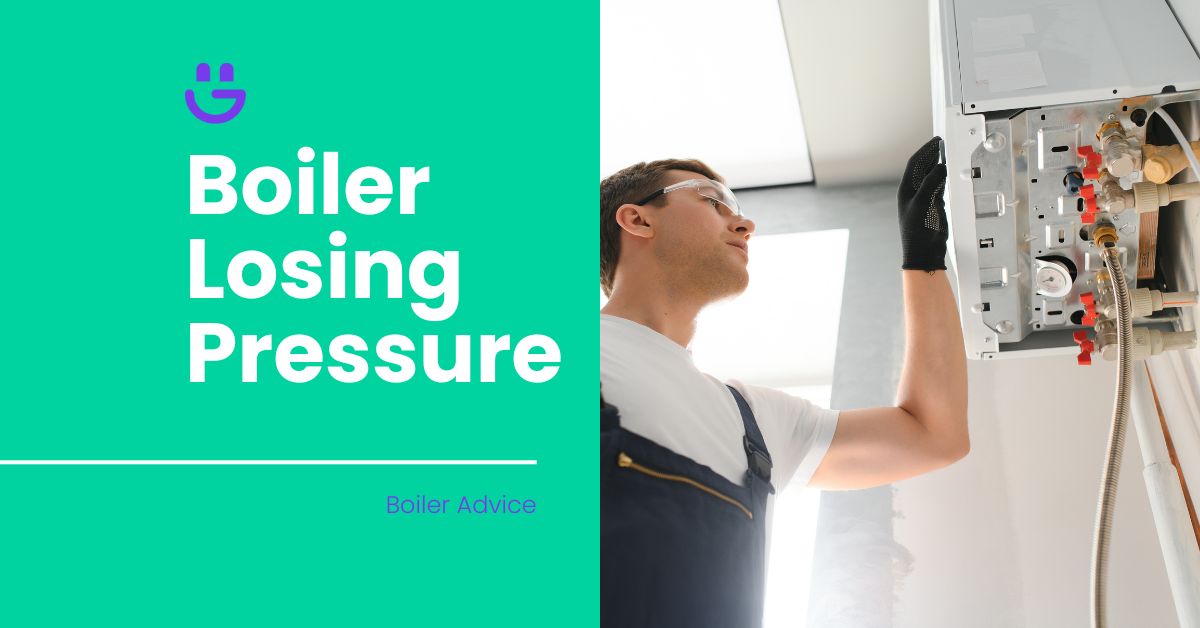
- Boiler losing pressure
- Boiler pressure too high
- How to bleed a radiator
- How to repair a boiler leak
- How to reset a Worcester boiler
- Boiler airlock
- Eco Happy boiler advice hub
Eco Happy Installs Limited (FRN 1051640) is a credit broker working with a panel of lenders. We are authorised and regulated by the Financial Conduct Authority as a credit broker, not a lender. The availability of finance and the terms offered will depend on your individual circumstances. Credit is subject to status, affordability and lender approval. Terms and conditions apply.