
Last Updated on November 9, 2026
Air conditioning advice · November 2026
Portable units are cheap to buy and easy to move. Split systems are quieter, cheaper to run and heat as well as cool. Here’s how to decide in 30 seconds.
 4.6 on Trustpilot · 655 reviews (November 2026)
- ✔ Fully installed from £2,160
- ✔ F-Gas certified engineers
- ✔ Heats and cools
Contents
- 1 Quick decision box
- 2 How each system works
- 3 Cost to buy vs cost to install
- 4 Running costs and noise
- 5 Heating capability
- 6 Installation, F-Gas and planning
- 7 Renters and landlords
- 8 Outgrown your portable? Next steps
- 9 What our customers say
- 10 Split vs portable air conditioning FAQs
- 11 Ready to ditch the portable?
Quick decision box
Choose a portable if…
You rent and can’t make changes to the walls.
You only need cooling for a few hot days a year.
You want to move it between rooms.
Your budget is a few hundred pounds today.
Choose a split system if…
You want to cool (or heat) a bedroom, office or living room regularly.
You want it quiet enough to sleep with it on.
You want lower running costs over several summers.
You’d like heating in spring and autumn too.
Our verdict
For regular use in a room you care about, a split system is usually quieter, more efficient and more effective than a portable. A portable wins on upfront price and flexibility, especially for renters, but it vents heat through a window hose and typically costs more to run.
It’s the middle of a heatwave, the bedroom is unbearable and a portable air conditioner is one click away. Before you buy, it’s worth knowing what you’re getting, and when a fixed split system is the better buy.
How each system works
Portable air conditioner
One box on wheels that sits in the room. It pulls in warm air, cools it and pushes the heat out through a hose that goes out of a window. The compressor (the noisy part) is in the room with you.
Split system
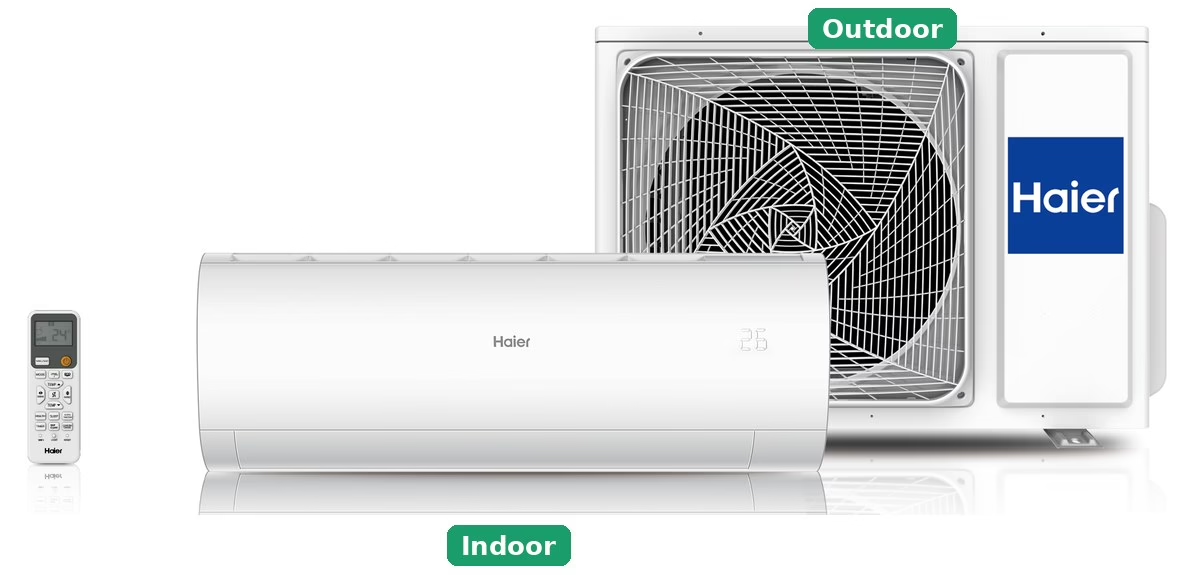
An indoor wall unit linked by refrigerant pipes to an outdoor unit. The compressor and fan that dump the heat sit outside, so the indoor unit is quieter and there’s no hose or gap in the window.
Cost to buy vs cost to install
| Portable unit | Split system (1 room) | |
|---|---|---|
| Upfront cost | £300 to £1,000 (UK market) | £1,800 to £3,500 installed (UK market); Eco Happy from £2,160 fully installed |
| Installation | Plug in and fit the window hose yourself | Professional F-Gas installation, usually done in a day |
| Running cost (Heatable estimate) | About 20p to 25p per hour | About 7p to 12p per hour for an efficient unit |
| Noise | Compressor in the room, so noticeably louder | Compressor outside, so much quieter indoors |
| Heating | Some models; usually inefficient | Most are reversible air-to-air heat pumps |
| Window | Needs to stay partly open for the hose | Closed; pipes go through a small hole in the wall |
| Can you move it? | Yes | No, it’s fixed to the wall |
Running cost per hour, upper end of each estimate (pence)
Why does a split cost more? You’re paying for an indoor unit, an outdoor unit, refrigerant pipework, electrical work and commissioning by qualified engineers. A portable is just an appliance. See the full breakdown in our air conditioning installation cost guide.
Running costs and noise
Portables are less efficient because the hot hose and the gap around it let heat back in, and the unit has to work harder to cool the same room. Heatable estimates an efficient split at about 7p to 12p per hour against 20p to 25p per hour for a portable. Over a few summers of regular use, that difference adds up. Read more in our guide to air conditioning running costs.
Noise is often the deal-breaker. Because a portable’s compressor is in the room, many people find it too loud to sleep with on. A split’s indoor unit just has a quiet fan.
Heating capability
Most modern split systems are reversible, which makes them air-to-air heat pumps. The same unit that cools your bedroom in July can heat it efficiently in October, using less electricity than a plug-in heater for the same warmth. That year-round use is a big part of the value case for a split. The Haier Pearl Premium units we install heat and cool.
Installation, F-Gas and planning
- F-Gas rules: work with refrigerants must be done by F-Gas qualified engineers. A split system isn’t a DIY job; a portable is.
- Planning: many houses won’t need planning permission, but flats, listed buildings and conservation areas may. Check our planning guide.
- Electrics: a split needs a suitable electrical supply to the outdoor unit. We include this, with an isolation switch where required.
- Drainage: indoor units produce condensate, so we fit a drain or condensate pump, included where needed.
More detail in our air conditioning planning permission guide.
Renters and landlords
If you rent, a portable is often the only option, because a split system means drilling through an outside wall and fixing an outdoor unit. You’ll need written permission from your landlord (and, in a flat, often the freeholder). Landlords installing splits can add real value for tenants in top-floor flats and loft rooms.
Outgrown your portable? Next steps
If you’ve put up with a noisy portable for a summer or two, a split is the natural upgrade. Here’s how it works with us:
Tell us about your rooms
Add each room, its size and roughly how far the pipe needs to run to an outside wall.
See your fixed price
Get one fully installed Haier Pearl Premium package price, with pay-in-full and finance options.
Book and survey
Book with a £100 deposit and pick an install week (at least 2 weeks’ notice). We’ll send you a link to book a virtual survey.
Eco Happy split systems cost from £2,160 fully installed for one room. See prices for 1 to 5 rooms in our air conditioning installation cost guide, and monthly options in air conditioning on finance.
Cooling more than one room? Compare options in our split vs multi-split guide, see our pick of the best air conditioning units in the UK, or browse our air conditioning hub.
What our customers say
★★★★★
“They arranged a survey for the very next day and managed to complete the installation within just four weeks… most other companies I contacted were quoting installation dates well into 2027!”
Mr Gill, air conditioning · Trustpilot, Oct 2026
Rated 4.6 out of 5 from 655 reviews on Trustpilot (November 2026). Read all reviews, good and bad →
Split vs portable air conditioning FAQs
Is a split system better than portable air conditioning?
For regular use, yes. A split system is quieter, more efficient and more effective, and most can heat as well as cool. A portable is cheaper upfront and easy to move, which makes it a good choice for renters or occasional use.
Which is cheaper to run?
A split system. Heatable estimates an efficient split at about 7p to 12p per hour and a portable at about 20p to 25p per hour, at 24.67p per kWh.
Can I install a split air conditioner myself?
No. Work with fluorinated refrigerants must be done by F-Gas qualified engineers. Portable units don’t need this, which is why they’re a DIY purchase.
Can I move a split system between rooms?
No, it’s fixed to the wall. To cool more rooms, add a multi-split, where several indoor units share one outdoor unit.
Are portable air conditioners OK for flats?
Often yes, because there’s no outdoor unit to fit. A split in a flat usually needs permission from the landlord or freeholder, and sometimes planning permission.
Can a split system heat in winter?
Yes. Most modern split systems are reversible air-to-air heat pumps, so they heat efficiently as well as cool. The Haier Pearl Premium units we install heat and cool.
Ready to ditch the portable?
Get a fixed, fully installed split system price for your home in minutes.
Prefer to talk? Call us on 0114 387 7066.
Eco Happy Installs Limited (FRN 1051640) is a credit broker. Air con finance is provided by Zopa, subject to status. We are authorised and regulated by the Financial Conduct Authority as a credit broker, not a lender. The availability of finance and the terms offered will depend on your individual circumstances. Credit is subject to status, affordability and lender approval. Terms and conditions apply.